
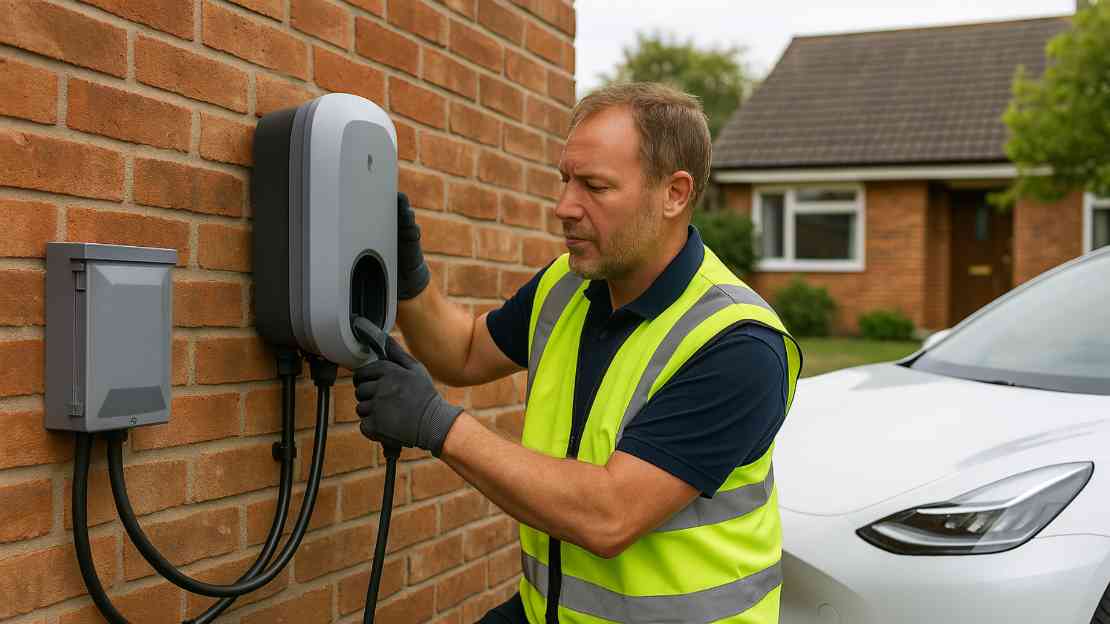
A typical home Level 2 charger draws up to 30 amps and needs a dedicated 40-amp circuit, according to the U.S. Department of Energy’s Alternative Fuels Data Center. That makes the installed price in Fort Worth the sum of four parts: the charger, the 240-volt circuit that feeds it, any panel work needed to make room, and the city permit.
Which part grows depends on the house. One home has an open slot in its panel ten feet from the garage; the next has a full panel on the far side of the house. No agency publishes an installed Fort Worth price, so our licensed electricians look at your panel and parking spot first and give you one written number.
Every figure below was read at its source on October 28, 2026.
| What it measures | The figure | Who says so |
|---|---|---|
| Level 1 charging | 120 volts, about 5 miles of range per hour (at 1.9 kW); 8 hours adds about 40 miles to a mid-size EV | U.S. Department of Energy, Alternative Fuels Data Center |
| Level 2 charging | 240 volts in homes, about 25 miles of range per hour; units run 2.9 to 19.2 kW | Alternative Fuels Data Center |
| A typical home Level 2 unit | Up to 30 amps, delivering 7.2 kW, on a dedicated 40-amp circuit under National Electrical Code Article 625 | Alternative Fuels Data Center |
| How the circuit is sized | A continuous load: the circuit is rated for 125% of the charger’s maximum load, so a 40-amp circuit carries a 32-amp charge | ChargePoint, Home Flex Installation Guide |
| Fort Worth’s electrical code | 2026 National Electrical Code, effective September 1, 2026, with local amendments | City of Fort Worth |
| Fort Worth permit rule | A permit for work that changes, moves or repairs electrical | City of Fort Worth |
| Texas home electricity | 15.91 cents per kWh on average in August 2026 (15.40 cents in August 2025) | U.S. Energy Information Administration |
| Federal charger credit for a main home | 30% of cost, up to $1,000 per item, for property placed in service January 1, 2023 to June 30, 2026, in an eligible census tract | IRS |
Read the table as a description of the work. The Department of Energy’s charging-level figures put a typical home unit at 30 amps on a 40-amp dedicated circuit, which means a new breaker, wire sized for 40 amps all the way to the charger, and a panel with room for both. The longer that run and the fuller the panel, the more the job costs.
The 40 amps come from the continuous-load rule. A car can pull full power for hours, so ChargePoint’s installation instructions for its Home Flex charger requires a circuit rated for 125% of the charger’s maximum load. A 30-amp charger times 1.25 is 37.5 amps, which a 40-amp circuit covers.
The cheapest charger may already be in your trunk. Most EVs ship with a Level 1 cord, and the AFDC says many owners meet their daily driving that way with no added cost or installation, provided an outlet on a dedicated branch circuit sits near where they park. A garage outlet shared with the freezer and the lights is not that, and adding a 120-volt circuit is still electrical work that needs a Fort Worth permit.
The IRS rules for the 30C refueling property credit cover a charger at your main home only if it was placed in service by June 30, 2026, in a low-income or non-urban census tract, claimed on Form 8911. A charger installed in Fort Worth today falls outside those dates. We are electricians, not tax preparers, so take an earlier install to whoever does your return.
The install is paid once; the electricity is paid every week. The EIA’s average residential electricity price by state puts Texas homes at 15.91 cents per kilowatt-hour in August 2026, the newest month published. The AFDC’s own worked example uses a car that needs 27 kWh to go 100 miles and a 54 kWh battery good for about 200 miles. At the Texas rate, our arithmetic gives:
| AFDC example | Energy used | Cost at 15.91 cents per kWh |
|---|---|---|
| Driving 100 miles | 27 kWh | About $4.30 |
| Filling a fully empty battery (about 200 miles) | 54 kWh | About $8.59 |
When we price a Level 2 install in a Fort Worth home, four things decide the number.
Level 2 units run from basic models with standard safety features and status lights to smart units with charging timers, data collection and keypads, the AFDC says, and it recommends safety-certified equipment such as ENERGY STAR certified chargers. Some plug into a 240-volt outlet and some are hardwired; ChargePoint’s Home Flex, for one, plugs in only on a 40- or 50-amp circuit and must be hardwired on any other. Tesla vehicles come with a J1772 adapter, so they can use other brands’ Level 2 chargers.
The wire runs from the panel to wherever the car parks, sized for the full circuit the whole way. A charger on the garage wall behind the panel is a short run. One on a detached carport, or at the far end of the house with the wire going through a hot attic, is a long one and costs more. Outdoor mounting is safe with outdoor-rated equipment, the AFDC says, even when the car charges in the rain.
Every amp the charger draws comes through the main panel, on top of the air conditioner, water heater, range and dryer. The Department of Energy notes that some homes lack the capacity for Level 2 equipment and that an electrician can add circuits to make room. Sometimes a reworked layout in the existing panel is enough. Sometimes the house needs a bigger panel with room for the charger and every load it already runs, which is what turns a modest install into a larger project. We check the panel before we quote the charger, so both prices arrive together.
The City of Fort Worth’s residential permitting rules require a permit for work that changes, moves or repairs electrical, and a new 240-volt circuit is a change. The applicant must be a registered contractor or a homeowner who qualifies for a homestead permit on the house they own and live in. We pull the permit and meet the inspector, and the fee sits inside our quote rather than arriving later.
The code changed this year. The City of Fort Worth has enforced the 2026 National Electrical Code, with local amendments, since September 1, 2026, and the AFDC notes that Article 625 of that code holds most of what applies to charging equipment. A charger permitted today is inspected against that edition, and our electrical license is TECL-38309.
Where you live matters as much as what you drive. In an apartment or condo building, the AFDC says charging requires additional considerations and may be more like public charging than charging at a single-family home, so the building owner or association has to be part of the decision. In a house, many older Fort Worth panels are already close to full. A newer house is not an automatic yes either: a big home with two air conditioners and a pool pump can fill a panel just as quickly. We install chargers across the city, including new homes in Alliance and far north Fort Worth, and the panel check comes first in each one.
A Level 1 cord in a working outlet needs no electrician. Call us when:
Our electricians handle Level 2 charger installation in Fort Worth homes, permit to final inspection, on one written price.
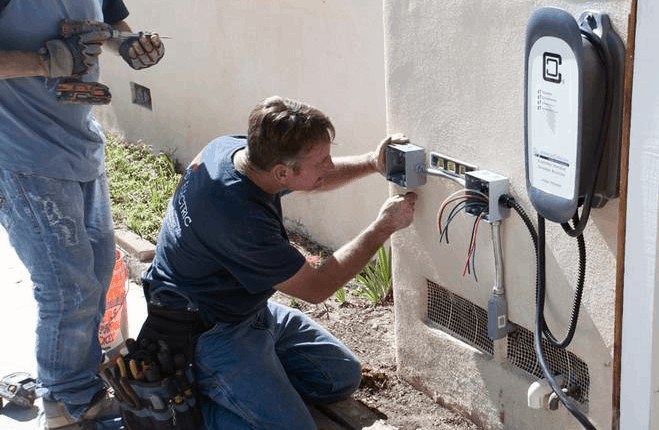
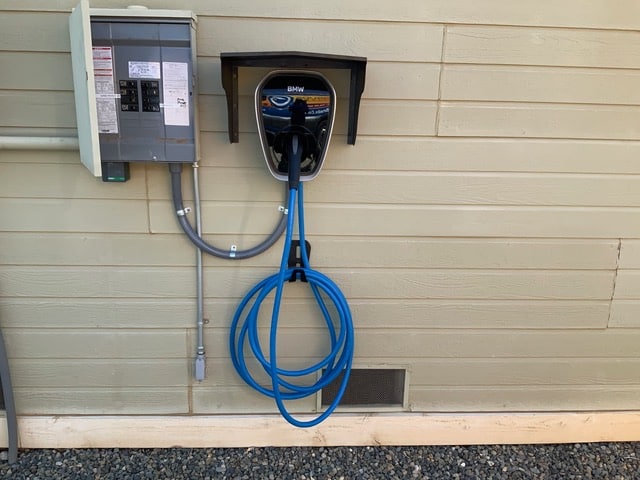
Tell us where the car parks and what you plan to buy, and we will look at the panel and the wire route before we put a number on it. We book visits Monday to Friday from 7 a.m. to 6 p.m. and Saturday from 8 a.m. to 3 p.m., and the same visit can cover any other licensed electrical work the house needs.
It depends on four parts, and no public agency publishes a Fort Worth installed price. The charger, a dedicated 40-amp circuit for a typical 30-amp unit (the Department of Energy’s figure), any panel work and the city electrical permit set the total, so we price it in writing after seeing your panel.
Yes. EV charging is a continuous load, and ChargePoint’s Home Flex installation guide says the circuit must be rated for 125% of the charger’s maximum load. Thirty amps times 1.25 is 37.5, which is why the Department of Energy pairs a typical 30-amp home charger with a dedicated 40-amp circuit.
Not under the dates the IRS lists. Its 30C credit page, read October 28, 2026, covers property placed in service at a main home from January 1, 2023, to June 30, 2026, in an eligible low-income or non-urban census tract only. Ask your tax preparer about anything installed earlier.
About $4.30 per 100 miles at the EIA’s August 2026 Texas average of 15.91 cents per kWh, for a car using 27 kWh per 100 miles. Filling an empty 54 kWh battery at that rate costs about $8.59. Your own electricity plan’s rate sets your real cost.
Often. The Level 1 cord plugs into a standard outlet and adds about 40 miles over an 8-hour night, the Department of Energy says. If that covers your daily driving and the outlet is on its own circuit near your parking spot, there is nothing to install.
Same day appointments across Fort Worth & Tarrant County. Fully-stocked trucks, friendly uniformed techs, upfront flat-rate pricing, call now and we’ll be there.

Monday to Friday: 7 am to 6 pm
Saturday: 8 am to 3 pm
Sunday: Closed
Emergency line answered 24/7: 817-290-3373
License #: TACLB00028662E | M46192 | TECL-38309