
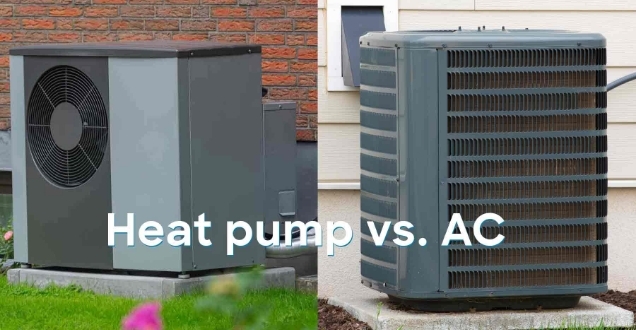
In summer, a heat pump and a central air conditioner do the same job: both pull heat out of the house, and federal rules in 10 CFR 430.32 set the same 14.3 SEER2 cooling floor for a new split heat pump and a split air conditioner under 45,000 Btu per hour installed in Texas. The difference is winter, when a heat pump runs in reverse to heat the home and an air conditioner leans on a furnace.
So the fair comparison is a heat pump against an air conditioner plus whatever heats your house now. A home on electric heat strips stands to gain the most from a heat pump; a home with a newer gas furnace may do better keeping it. We price both options for your house in writing.
| Central air conditioner | Heat pump | |
|---|---|---|
| What it does | Cools only; a furnace supplies heat | Cools in summer and heats in winter from one outdoor unit |
| Federal minimum, new split system in Texas | 14.3 SEER2 under 45,000 Btu per hour, 13.8 SEER2 at or above (installed since Jan. 1, 2023) | 14.3 SEER2 for cooling and 7.5 HSPF2 for heating (made since Jan. 1, 2023) |
| Winter heat comes from | A gas furnace (federal minimum 80 percent AFUE today) or an electric furnace | The heat pump itself, with supplemental heat for the coldest nights |
| DOE average lifetime, hot-humid region (includes Texas) | 18.0 years | 15.1 years |
| DOE modeled installed cost, in 2015 dollars | $4,011 (14 SEER, hot-humid region, air conditioner only) | $5,246 (14 SEER and 8.2 HSPF, national) |
The ratings. SEER2 measures cooling over a season and HSPF2 measures heating over a season; a higher number means more cooling or heating per unit of electricity. Texas sits in the federal “Southeast” region, which is why a new split air conditioner here has a higher floor than the national 13.4 SEER2. A split heat pump carries the 14.3 SEER2 floor nationwide, plus the 7.5 HSPF2 heating floor.
The lifetimes. DOE’s figures are averages from a model calibrated on historical shipments, not a promise for any one unit. The heat pump comes in about three years shorter, and DOE ties part of a unit’s expected life to its operating hours: a heat pump’s compressor works through winter as well as summer. The same hours logic is why an air conditioner in Texas wears out sooner than one in a northern state.
The installed costs. These are the only primary-source installed cost figures we found, and they are DOE’s modeled averages for baseline equipment in 2015 dollars. The air conditioner figure covers the air conditioner alone, with no furnace. Read them as proof that a heat pump costs more than an air conditioner on its own, not as a 2026 price; we quote yours in writing after a visit.
To compare heating systems on equal terms, we priced the same amount of heat delivered into the house: one million Btu. The arithmetic uses Texas residential energy prices from the U.S. Energy Information Administration, EIA’s Btu conversion factors (3,412 Btu per kilowatt-hour, 1,036 Btu per cubic foot of natural gas) and the federal minimum ratings.
| Heating setup | Energy needed for 1 million Btu of heat | Cost at Texas average prices |
|---|---|---|
| Heat pump at the federal minimum, 7.5 HSPF2 | 133 kWh | about $21 |
| Electric resistance heat (electric furnace or heat strips) | 293 kWh | about $47 |
| Gas furnace at the federal minimum, 80 percent AFUE | 1.21 thousand cubic feet | about $22 |
| Gas furnace at 95 percent AFUE | 1.02 thousand cubic feet | about $18 |
Against electric resistance heat, the heat pump wins clearly. At the minimum rating it delivers about 2.2 times as much heat per kilowatt-hour as heat strips over a rated season, and higher-rated models do better. Against gas it is close: a minimum-rated heat pump and a minimum-rated furnace land within about a dollar of each other, and a 95 percent furnace comes out a few dollars cheaper. Your own electric and gas rates decide it.
Treat the table as a way of thinking, not a bill forecast. Monthly gas prices swing hard (EIA’s Texas figure ran from $16.47 per thousand cubic feet in January 2026 to $34.30 in July), and HSPF2 is rated in a standardized federal test climate, not a Fort Worth winter. On the coldest nights, any supplemental electric heat runs at the cost in the second row. The cooling side does not change: a heat pump and an air conditioner with the same SEER2 rating cool for the same power.
These are the setups we are asked about most. Every house differs, so treat each as the starting point for a quote, not a verdict.
This is where a heat pump makes its strongest case. The cooling side costs the same, and the heating side moves from the $47 row of the running-cost table to the $21 row. If the outdoor unit is due for replacement anyway, the heat pump is the option to price first.
ENERGY STAR describes this exact case: put in a heat pump instead of a new air conditioner and keep the furnace, creating a dual-fuel system “for a modest extra cost over an AC system.” The heat pump handles mild winter days, the furnace takes the colder ones, and a furnace you already paid for stays in service.
Here we price both paths: a heat pump with supplemental heat, against an air conditioner replacement paired with a new gas furnace. With gas and electric heat this close in cost, your own rates, your ducts and gas line, and the lifetimes in the first table usually decide it. If only the furnace is failing and the cooling side has years left, gas furnace repair can buy time to plan.
An addition, a converted garage or an older home without ducts does not have to wait for a central system. ENERGY STAR notes that where running ductwork would be difficult, a heat pump can still heat and cool part of a house: a ductless mini-split heat pump mounts on an inside wall or ceiling and serves those rooms on its own.
ENERGY STAR warns that a system too large or too small for its space “will struggle to meet your home comfort needs,” and says a contractor should verify the right size with a Manual J calculation, the method for working out how much heating and cooling a home needs. Whichever system you lean toward, we start with that load calculation: square footage, insulation, windows and ductwork.
Most Fort Worth homes already heat with electricity. In the Census Bureau’s American Community Survey (2020 to 2024, table B25040), electricity is the main heating fuel in about 68 percent of the city’s 342,126 occupied homes and utility gas in about 30 percent, against about 61 and 35 percent statewide. The survey does not split heat pumps from heat strips, but for every one of those electric homes, the first two rows of the running-cost table are the comparison that matters.
Our winters are short, with a handful of hard nights. We counted NOAA’s daily lows at DFW Airport for the 30 winters from 1991-92 to 2020-21: about 29 freezing nights a winter, about 8 at 25 degrees or below, fewer than 3 at 20 or below (in 20 of the 30 winters), and 10 or below in only 2 winters, bottoming at minus 2 on February 16, 2021. ENERGY STAR advises homes where winters regularly dip below freezing to plan a heat pump with a backup heating system where it makes sense, so for homes from Haltom City out to Keller, the supplemental heat deserves its own line in any heat pump quote you compare.
A breakdown in August turns this into a one-afternoon decision. Price both options now if:
We quote a heat pump installed for a Fort Worth winter next to the AC option, ratings shown.


Bring a recent winter electric bill and gas bill to the visit. The rates on them replace the statewide averages in our running-cost table, and that usually settles the heat pump against gas question. We work across Fort Worth from our Haltom City office, Monday to Friday 7 to 6 and Saturday 8 to 3, with a 24/7 emergency line.
For a home on electric heat, usually the heat pump. At EIA’s Texas average electricity price for January to August 2026, a heat pump at the 7.5 HSPF2 federal minimum makes a million Btu of heat for about $21, against about $47 from heat strips. Against a gas furnace the two run close, so your own rates decide it.
It is close either way. Using EIA’s Texas residential prices (electricity January to August 2026, gas December 2025 to February 2026), a minimum-rated heat pump cost about $21 per million Btu of heat, an 80 percent gas furnace about $22 and a 95 percent furnace about $18.
Yes. ENERGY STAR calls this a dual-fuel system: the heat pump replaces the air conditioner and heats on milder days, and the gas furnace takes over when that makes more sense. ENERGY STAR puts the cost at a modest extra over an air conditioner alone, and it suits a home whose furnace is newer than its air conditioner.
Fewer than three on average. NOAA’s daily record for DFW Airport over the winters of 1991-92 through 2020-21 shows lows of 20 degrees or below in 20 of those 30 winters, and 10 degrees or below in only two. Freezing nights, 32 degrees or below, averaged about 29 a winter.
On DOE’s model, by about three years. The Department of Energy’s 2017 rule puts the average heat pump lifetime in the hot-humid region, which includes Texas, at 15.1 years against 18.0 for a central air conditioner, because a heat pump’s compressor runs in winter as well as summer.
Same day appointments across Fort Worth & Tarrant County. Fully-stocked trucks, friendly uniformed techs, upfront flat-rate pricing, call now and we’ll be there.

Monday to Friday: 7 am to 6 pm
Saturday: 8 am to 3 pm
Sunday: Closed
Emergency line answered 24/7: 817-290-3373
License #: TACLB00028662E | M46192 | TECL-38309