
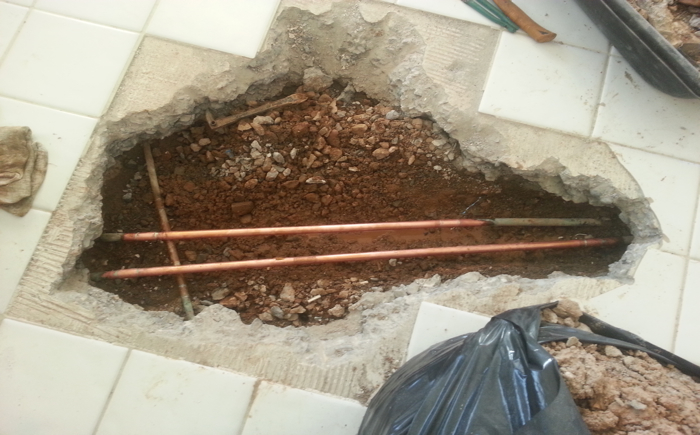
A slab leak repair in Fort Worth is priced from three things: where the leak sits under the slab, which repair fits the pipe (a spot repair, a reroute or a repipe), and how much concrete, flooring and wall has to be opened and put back. No government agency or utility publishes a Fort Worth price, so we locate the leak first and quote each option in writing.
Timing changes the bill around the repair as well. Fort Worth Water sets each household’s sewer volume for the year from water used between December 1 and the end of February, so a leak left running into winter keeps costing after the pipe is fixed. If your meter moves with every tap closed, call us and we will find the leak before anyone prices it.
Fort Worth Water bills by the CCF, one hundred cubic feet, which the city puts at 748.1 gallons. Residential water is billed in tiers, so each extra CCF a leak adds costs more once a household is already using a lot.
| Residential charge, inside city limits | 2026 rate per CCF | 2027 rate per CCF |
|---|---|---|
| Water, first 6 CCF a month | $2.28 | $2.28 |
| Water, over 6 to 12 CCF | $3.19 | $3.19 |
| Water, over 12 to 24 CCF | $4.29 | $4.35 |
| Water, over 24 CCF | $5.37 | $5.60 |
| Wastewater, all billed volume | $4.30 | $4.33 |
The water side is small. Take a leak losing 50 gallons a day, a rate we chose for the arithmetic rather than a measured Fort Worth average. Over a 30-day month that is about 1,500 gallons, roughly 2 CCF, which adds between $4.56 and $11.20 to a monthly bill at the 2027 rates, depending on the tier your household already reaches.
The sewer side lasts a year. The city averages December, January and February water use to set the wastewater volume on every bill from April onward. Two extra CCF in that average, at the 2027 wastewater rate of $4.33, comes to about $8.66 a month, or close to $104 across 12 bills. That is our arithmetic on the city’s published rates, not a figure Fort Worth Water states, and a faster leak multiplies it.
What the table leaves out. Every bill also carries a fixed monthly service charge set by meter size, which a leak does not change. The 2027 rates first apply to the bill customers receive in February 2027.
Clay that swells when wet and shrinks as it dries moves whatever sits on it, including a slab and the supply lines under it. We placed evenly spaced points inside the City of Fort Worth’s mapped boundaries for eight registered neighborhood organizations and looked each one up in the U.S. Department of Agriculture’s Soil Data Access service, using its “Dwellings on Concrete Slab” rating for Texas.
| Neighborhood (city boundary used) | Points checked | Flagged high shrink-swell | Rated very limited for slab homes | Most common soil series |
|---|---|---|---|---|
| Fairmount | 25 | 23 | 13 | Sanger, Bolar |
| North Side | 18 | 18 | 4 | Bolar, Sanger |
| Westcliff (Westcliff and Westcliff West) | 17 | 17 | 8 | Sanger, Bolar |
| Wedgwood (Wedgwood East, Wedgwood South, Wedgwood Square) | 17 | 16 | 7 | Sanger, Bolar |
| Ridglea Hills | 17 | 15 | 2 | Bolar, Aledo |
| Arlington Heights | 15 | 14 | 1 | Aledo, Luckenbach |
| Tanglewood | 11 | 11 | 5 | Bolar, Frio |
| Heritage (far north) | 17 | 9 | 8 | Aledo, Sanger |
In the seven close-in neighborhoods, the few points without a flag fell on land the survey maps as urban land and does not rate. Heritage differs: seven of its 17 points sit on Aledo and Bolar soils the survey limits for shallow bedrock rather than for swelling. In Wedgwood, all seven very limited points sit on Sanger clay, so the lines we repair for homeowners across Wedgwood and South Hills run under slabs on ground that moves with the seasons.
The rating describes the ground, not the plumbing, so it cannot say whether your pipes will leak, and a neighborhood sample says nothing about one lot. It does show that a slab over moving clay is the normal condition across much of Fort Worth, which is why we look at the whole line before recommending a one-joint repair.
Every slab leak quote we write comes from the same handful of questions, and the answers turn one job into a short visit and another into a multi-day project.
A leak under a bathroom floor near an outside wall is easier to reach than one under a kitchen island or close to a load-bearing wall. Depth and the distance from the nearest workable access point decide how much concrete has to come out, and that sets most of the labor.
A hot-side leak wastes the gas or electricity that heated the water as well as the water, and it often shows as a warm patch of floor; a cold-side leak can run quietly for months. Copper, PEX and cast iron are repaired differently. When a second leak turns up on the same worn line, replacing the supply lines throughout the house can make more sense than opening the slab again.
A spot repair opens the slab over the leak. A reroute runs a new line through the walls or attic and leaves the slab closed, trading concrete work for drywall and ceiling work. A repipe replaces the supply lines through planned openings across the house. Fort Worth requires a plumbing permit for changing, installing, moving or repairing plumbing, a building permit once replaced drywall reaches 16 square feet or more in any wall or ceiling, and building permits with engineered plans for any residential foundation repair, according to the city’s residential permit rules. We list the permits each method needs before you choose.
Tile, wood, carpet, cabinets and drywall each come back at a different cost, and the finish over a leak often costs more to restore than the plumbing costs to fix. A reroute avoids most floor restoration; a spot repair under tile does not.
Wet flooring, swollen cabinets and damaged walls are a separate cost from the pipe repair, and they are the part to raise with your insurer. The Texas Department of Insurance says home insurance coverages vary by company, that most policies cover a sudden and accidental release of water but not a continuous water leak or earth movement, and that damage to foundations or slabs is a common endorsement. Ask your agent which applies before the slab is opened, because an adjuster may want to see the damage.
Two Fort Worth Water rules decide how much of a leak’s water cost stays with you. The first is the winter quarter average: household use from December 1 through the end of February sets the billable sewer volume, and the new average starts on the April bill. A leak found in Fairmount in late November costs less than the same leak left running in Heritage until March, even when the repair itself costs the same.
The second is the water leak repair adjustment. The city names a hidden leak beyond your control, such as one under the foundation, as the kind that may qualify. Up to two consecutive billing periods can be credited at 50 percent of the use above your average, and you apply within 60 days of the completed repair with the receipt or paid-in-full invoice, your account number, the property address, the range of high bill dates, and the date and description of the repair. One adjustment is allowed per 12 months, and filling a pool or putting in new landscaping during the high-use period can disqualify a claim. The city does not say whether the credit changes a winter average, so ask when you apply.
A leak found before winter stays out of a year of sewer bills. Book a search if:
That is when electronic and acoustic leak location under the slab pins the price to a known spot. Water coming up through the floor? Shut off the main and call our 24/7 line.
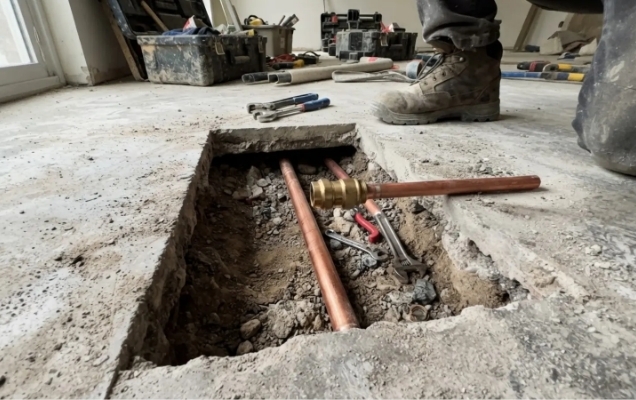
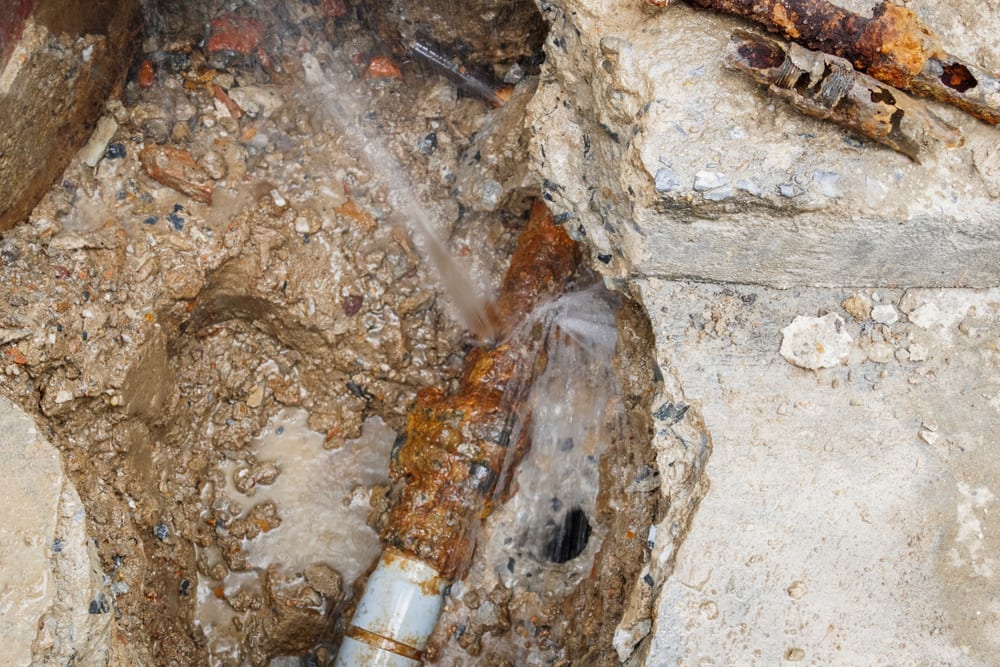
A slab leak quote is only as good as the spot it is built on. We locate the leak, then price the spot repair, reroute or repipe side by side with the permits each one needs. When the repair is done, ask us for the paid invoice with the repair date and a description of the work written out, since that is what a Fort Worth Water leak adjustment application asks for.
No public figure exists: no government agency or utility publishes a slab leak repair price for Fort Worth homes. Your cost depends on where the leak sits, whether it needs a spot repair, reroute or repipe, the permits that method brings, and how much flooring and wall must be restored. We quote each option in writing after locating the leak.
It can. Fort Worth Water sets your billable sewer volume for the year from water use between December 1 and the end of February, starting with the April bill. A leak running in those months raises that average, so its cost shows up on every bill until the next winter resets it.
That depends on the policy. The Texas Department of Insurance says most home policies cover a sudden and accidental release of water but not a continuous leak or earth movement, and coverage for damage to foundations or slabs is a common add-on endorsement. Ask your agent which applies before the slab is opened.
At least a plumbing permit, since Fort Worth requires one for changing, installing, moving or repairing plumbing. Replacing 16 square feet or more of drywall in any wall or ceiling adds a building permit, and any residential foundation repair needs a building permit with engineered plans. We list the permits your method needs on the quote.
Sometimes. A reroute runs a new supply line through the walls or attic and leaves the slab closed, which avoids concrete and floor restoration. It adds wall and ceiling openings instead, and in Fort Worth enough drywall work brings a building permit, so the cheaper slab leak repair depends on your house. We price both.
Same day appointments across Fort Worth & Tarrant County. Fully-stocked trucks, friendly uniformed techs, upfront flat-rate pricing, call now and we’ll be there.

Monday to Friday: 7 am to 6 pm
Saturday: 8 am to 3 pm
Sunday: Closed
Emergency line answered 24/7: 817-290-3373
License #: TACLB00028662E | M46192 | TECL-38309