
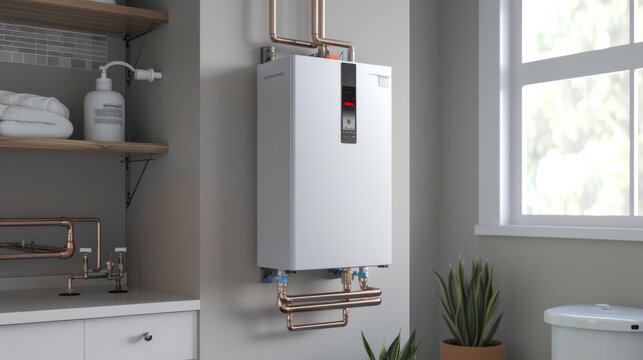
A tank water heater keeps a stored supply hot, while a tankless unit heats water only while a tap runs, so nothing sits waiting and losing heat. ENERGY STAR gives a tankless water heater a 20-year life expectancy, and its criteria ask a certified gas tankless unit for a 0.95 uniform energy factor against 0.81 for a certified medium-draw gas tank.
For a particular Fort Worth house, the choice turns on how much hot water runs at once, whether the gas line and vent can feed a tankless burner, how long you plan to stay, and how you will handle the city’s hard water. We install both kinds, so we can price them side by side after one visit.
Every residential water heater carries a uniform energy factor, or UEF: the federal test rating for how much of the energy it draws ends up as hot water over a standard day. Higher is better. The federal efficiency standard in 10 CFR 430.32 sets a floor by fuel, tank size and draw pattern (a test category based on how much hot water the heater delivers), with a second, stricter table for heaters manufactured on or after May 6, 2029. ENERGY STAR sets a higher line a model has to clear to carry its label.
| Type, example size | Federal floor today | Federal floor from May 6, 2029 | ENERGY STAR line |
|---|---|---|---|
| Gas tank, 40 gallons, medium draw | 0.58 | About 0.64 | 0.81 or higher |
| Gas tank, 50 gallons, high draw | 0.63 | About 0.68 | 0.86 or higher |
| Gas tankless, any draw | 0.80 to 0.81 | No new row in the 2029 table | 0.95 or higher |
| Electric tank, 50 gallons, medium draw | 0.92 | 2.30 | Heat pump models only: 3.30 (2.20 on a 120-volt circuit) |
| Electric tankless, any draw | 0.91 to 0.92 | 0.91 to 0.92 | No ENERGY STAR category |
Gas. The federal floor for a gas tankless unit already sits where ENERGY STAR draws its line for a medium-draw gas tank, and a certified tankless unit has to reach 0.95. The 2029 table raises the gas tank formulas a few hundredths, which narrows that gap without closing it.
Electric. A resistance tank and an electric tankless unit rate almost the same today, so the electric tankless case rests on space and continuous flow rather than efficiency. From May 2029, a 20 to 55 gallon electric tank (outside a separate small class of 20 to 35 gallons) needs 2.30, and a 55 to 120 gallon tank needs 2.50.
Bills. ENERGY STAR estimates a certified gas tankless unit saves a family of four $95 a year on gas, about $1,800 over its life, against a standard gas tank, and $20 a year against a conventional gas tankless model. Those are national estimates, not a Fort Worth bill.
The two types are sized in different units, and mixing them up is how a new water heater ends up too small. A tank is sized by what it holds and by its first-hour rating, the hot water it can deliver in a busy hour under test conditions. A tankless unit is rated by how many gallons per minute (GPM) it can heat at once.
| Fixture running | Typical hot water flow |
|---|---|
| Shower or bathtub | 2.5 GPM |
| Clothes washer | 3.3 GPM |
| Kitchen or bathroom sink | 2.2 GPM |
| Dishwasher | 1.3 GPM |
Add up what might run together. Two showers and the washer come to 8.3 GPM; one shower and the dishwasher come to 3.8. ENERGY STAR’s water heater criteria only require a certified gas tankless unit to deliver 2.8 GPM over a 67-degree temperature rise, enough for one shower with a little to spare, and require a certified gas tank to reach a first-hour rating of at least 51 gallons.
The temperature rise matters as much as the flow figure. Water arriving colder in January needs a bigger lift on its way through, which leaves less flow at full temperature, so we size a tankless unit for the coldest-month peak rather than an average day.
ENERGY STAR’s product definitions cap a residential gas tank at 75,000 Btu per hour of input, while a gas tankless unit can run up to just under 200,000. A tankless burner can ask the gas line for far more at once than the tank it replaces, and ENERGY STAR’s own buying advice is to have the installer check whether the existing line is big enough. When it is not, the line is upsized as part of the job.
A tankless unit exhausts differently from the tank it replaces, so switching types usually means new venting, which we price on the written quote. ENERGY STAR tells buyers to confirm how combustion gases will be vented and whether electricity is available near the heater for forced-ventilation models. An electric tankless unit needs enough spare panel capacity for its heating elements, which some older panels do not have.
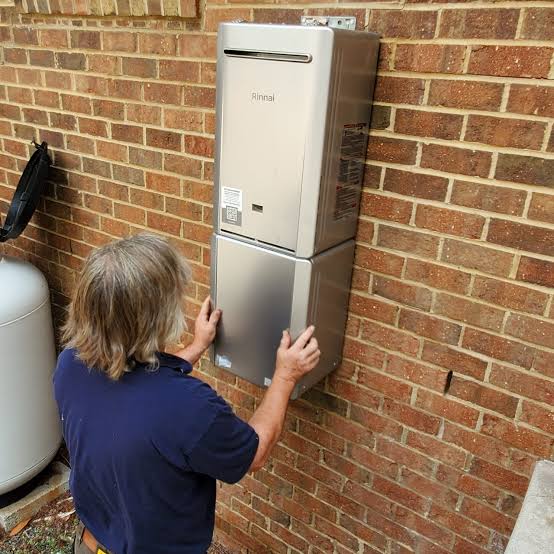
ENERGY STAR describes gas tankless units as small and wall-mounted, saving about a closet’s worth of space against a gas tank, and notes that models built for outdoor installation free up more. In a tight garage or a hall closet where a tank crowds everything else, that alone can settle it.
A 20-year tankless life expectancy and the yearly gas savings both pay back over time. If you plan to stay, they favor tankless. If you expect to sell within a few years, a tank’s lower purchase price and simpler swap usually win, since the next owner collects most of the savings.
A resistance element cannot put more heat into the water than the electricity it uses, which caps it near 1.0. A 2.30 floor sits in heat pump territory, next to the 3.30 ENERGY STAR line for an integrated heat pump water heater, so our reading is that most full-size electric tanks made after May 2029 will be heat pump designs, with the placement needs that come with one. Like the heat pump that heats and cools a house, a heat pump water heater moves heat rather than making it. The rule goes by date of manufacture, so a tank already installed is not affected.
Fort Worth Water’s 2025 Water Quality Report, covering water tested in 2025, lists total hardness at 108 to 150 parts per million as calcium carbonate, or 6 to 9 grains per gallon. The report adds that the city’s water is usually hard enough to leave a coating inside metal pipes. That hardness reaches both designs, in different places. In a tank, minerals settle to the bottom as sediment, which insulates the water from the burner and causes the popping older tanks make. In a tankless unit, scale builds on the heat exchanger and slowly cuts flow and heat output.
So neither type is maintenance free here. We flush tankless units at least once a year, a tank benefits from regular flushing too, and we can tell you whether a water softener makes sense for your house. Gold Star Membership includes that annual water heater maintenance visit.
The paperwork is the same for both: we pull the City of Fort Worth plumbing permit on every water heater we install, whether the house is an older home in Ridglea and Ridglea Hills or a newer build on the north side.
The comparison turns urgent when the current heater gives you a reason:
On an older heater, any of these is the moment to choose between the two types before a leak chooses for you, and our water heater replacement crews swap a failing tank for either type, permit included. If the heater is younger and the fault is a thermostat, element or valve, the choice can wait while we handle repairs on tank and tankless heaters that still have years left.
We look at your gas line, vent, panel, floor space and peak demand, then give you a written quote for each type, with financing, before any work starts. You see both numbers on one sheet and pick the one that fits how your household actually uses hot water. Call 817-290-3373 or book a visit online.
Neither wins everywhere. A tank costs less to buy and swap, while a tankless unit lasts longer, with ENERGY STAR putting its life expectancy at 20 years. In Fort Worth the deciding questions are peak hot water demand, whether the gas line and vent can feed a tankless burner, and how long you will stay.
The uniform energy factor, or UEF, printed for each model. Under 10 CFR 430.32 the federal floor today is 0.81 for a gas tankless unit at medium draw and about 0.58 for a 40-gallon gas tank, and ENERGY STAR certifies gas tankless units only at 0.95 and above.
That depends on its flow rating and how cold the incoming water is. ENERGY STAR plans on 2.5 gallons per minute for a shower and 3.3 for a clothes washer, so two showers and a load of laundry need about 8.3, while a certified gas tankless unit only has to deliver 2.8 over a 67-degree rise.
For electric tanks of 20 to 55 gallons manufactured on or after May 6, 2029, outside a smaller 20 to 35 gallon class, the federal minimum UEF in 10 CFR 430.32 rises from about 0.92 to 2.30, a level that points to heat pump designs. Tanks already installed are not affected.
It builds scale on the heat exchanger if nobody flushes it. Fort Worth Water’s 2025 report puts total hardness at 6 to 9 grains per gallon, so we flush tankless units at least once a year here. A tank collects the same minerals as sediment, so it needs regular flushing as well.
Same day appointments across Fort Worth & Tarrant County. Fully-stocked trucks, friendly uniformed techs, upfront flat-rate pricing, call now and we’ll be there.

Monday to Friday: 7 am to 6 pm
Saturday: 8 am to 3 pm
Sunday: Closed
Emergency line answered 24/7: 817-290-3373
License #: TACLB00028662E | M46192 | TECL-38309