TL;DR
Circuit breakers trip more in summer because the tripping decision is thermal. A standard thermal magnetic breaker is calibrated at 40 degrees C, or 104 degrees F, of surrounding air, and the manufacturer’s curve assumes a cold start at that temperature.
Two things change in August: the panel enclosure runs hotter than the calibration point, and air conditioning turns a short intermittent draw into hours of near-continuous current. Together they eat the margin the breaker was designed around.
One reset after a single trip is normal homeowner behavior. A breaker that trips again, trips on a schedule, or feels warm through the deadfront is reporting a real fault, and in Texas everything behind the panel cover is licensed work.
What Actually Happens Inside a Breaker When It Trips
A common residential breaker has two separate trip mechanisms sharing one handle. The magnetic element handles the violent stuff: a dead short or a ground fault produces a current spike large enough to throw an armature and open the contacts in a fraction of a cycle. That one is fast and has nothing to do with the weather.
The thermal element is the one August exercises. It is a bimetal strip, two metals bonded together that expand at different rates, so the strip bends as it warms. Current passing through the strip heats it. Bend far enough and the latch releases.
That is the whole decision.
Notice what that mechanism cannot distinguish. The strip does not know whether it got warm from current or from the air around it. Both sources add.
Manufacturer trip curves say so plainly: the Siemens time-current characteristic for its thermal magnetic frames is published “Based on 40°C ambient, cold start,” and the same product guide states that “Standard QR breakers are calibrated at 40°C ambient temperatures. Operation at higher temperatures will require derating,” per the Siemens QR circuit breaker product guide.
Cold start matters as much as the ambient number. The curve describes a breaker that begins the event at room temperature. A breaker that has been carrying 80 percent of its rating since two in the afternoon is not cold. It is already partway up the bend.
Does Hot Weather Alone Trip a Breaker?
Seldom on its own. Outdoor air in North Texas does not reach the 104 degrees F calibration point often, and even when it does, an unloaded breaker sitting at that temperature has not bent far enough to release. What heat does is shrink the margin. A circuit that drew a comfortable 14 amps on a 20 amp breaker in March draws the same 14 amps in August, but now the breaker starts the afternoon warm instead of cool, so it takes fewer amp minutes to reach the trip point.
This is where most of the advice on the internet goes wrong. Search this question, and you will find article after article stating that breakers are calibrated at 77 degrees F. Manufacturer documentation for the common UL 489 lines says 40 degrees C, which is 104 degrees F, and the difference is not academic. If the calibration point were 77 degrees F, nearly every panel in Tarrant County would be derated all summer. Because it is 104 degrees F, the honest answer is narrower and more useful: the panels that get into trouble are the ones whose own enclosure temperature climbs past that figure, and enclosure temperature is a function of location, sun exposure, ventilation, and how hard the circuits inside have been working.
The Panel Location Nobody Thinks About Until August
Two identical houses on the same street can behave completely differently, and the variable is usually where the builder put the load center.
An interior utility closet on a conditioned hallway stays near room temperature all summer. That panel is running far below its calibration point and will never see a heat-related trip.
The garage is the other story.
A panel screwed to the back wall of an attached garage is a different machine. Fort Worth garages are uninsulated, unconditioned, and share a wall with an attic. On a normal August afternoon, they run well above the outdoor air temperature. Put that same panel on a west-facing exterior wall in direct sun from three o’clock onward, and the metal enclosure becomes a solar collector bolted to the trip mechanism.
What the enclosure adds on its own
Conductors under load give off heat, and inside a closed steel box that heat has nowhere to go. Manufacturers acknowledge this: molded case breakers are calibrated in open air without any enclosure, as specified by Underwriters Laboratories, which is why the same Siemens guide advises that continuous loads should not exceed 80 percent of the breaker rating for most applications. Twelve breakers all pulling hard on a July afternoon warm the box for each other.
What to look for on your own panel
Feel the deadfront cover with the back of your hand. Warm is common. Hot enough to be uncomfortable is not, and neither is a discolored breaker face, a buzzing that changes pitch when the air conditioner starts, or the smell of hot plastic near the panel. Those are the panel telling you something is happening behind the cover.
August in North Texas Is a Load Problem First
The grid data makes the seasonality obvious. ERCOT’s yearly peak demand records list the highest hour of every record year, and ten of the fourteen years on that table peaked in August: 2023, 2019, 2016, 2015, 2011, 2010, 2005, 2004, 2003 and 2000. The August 10, 2023 peak of 85,508 MW stood as the record until it was surpassed.
ERCOT notes in the same table that one megawatt serves roughly 250 residential customers during peak hours, which is a useful way to read those numbers. They are millions of houses doing exactly what yours is doing.
Local climate normals explain why. At DFW, the 1991 to 2020 normals give August a daily high of 95.8 degrees F and a daily low of 75.7 degrees F, with the daily normal high sitting at 97 degrees for the first thirteen days of the month, per the National Weather Service Fort Worth office records and normals table for DFW. The overnight number is the one that matters here. A normal August night in Fort Worth does not drop below the mid seventies, so the air conditioner keeps cycling, the panel never fully cools, and each day starts a little warmer than the last.
| Spring afternoon | August afternoon | |
| Outdoor air | 78 degrees F | 97 degrees F normal high at DFW |
| AC compressor | Short cycles, long off periods | Runs most of every hour |
| Panel enclosure | Near room temperature | Ambient plus conductor heat, no overnight recovery |
| Breaker starting point | Cold, as the trip curve assumes | Already warm before the load arrives |
| Result of a 14 amp draw | Nothing | Margin gone, trip possible |
The heat is not new information to anyone here. The same NWS office’s 100-degree day archive shows DFW reached triple digits for the first time this year on July 7, and the archive holds years like 2023 with 55 days at or above 100 and 2011 with 71. What is new is the load stacked on top: heat pumps, EV chargers on a dedicated circuit, second refrigerators in the garage, pool equipment, and a home office running through the hottest hours of the day.
Continuous Load Is the Code Concept Behind All of This
NFPA 70, the National Electrical Code, treats a load differently once it stops being occasional. A continuous load is one where the maximum current is expected to continue for three hours or more, and the code requires the overcurrent device on a branch circuit to be sized for the noncontinuous load plus 125 percent of the continuous portion. The practical inverse is the familiar 80 percent rule.
Read that against an August day. An air conditioner that runs forty minutes out of every hour from noon until nine at night has crossed the three-hour threshold many times over. So has a pool pump on a timer. So has the second refrigerator in the garage.
Texas runs on this code statewide rather than city by city, which is why the rules are the same in Saginaw, Benbrook, Keller and Fort Worth proper. NFPA publishes NFPA 70 on a three-year cycle, and the state adopts editions in turn. In March 2026, the Texas Department of Licensing and Regulation proposed adopting the 2026 NEC as the electrical code for the state, with one amendment removing the ground-fault requirement for outlets powering outdoor HVAC equipment. Anyone who tells you the code is a local matter in this metro is guessing.
How Many Times Is It Safe to Reset a Breaker?
Once.
Reset a tripped breaker one time to rule out a one-off event, then watch it. If it holds for the rest of the season, you found a temporary overload, and moving one appliance to another circuit is often the whole fix. If it trips again, stop resetting and get the circuit looked at.
The federal guidance is blunt about the pattern rather than the single event. The CPSC Guide to Home Wiring Hazards lists “fuses need replacement or circuit breakers need resetting frequently” among its warnings of potential hazards, and for a breaker that trips when one particular appliance, switch, or outlet is used, its instruction is to obtain help from a qualified electrician and not to install a higher-ampere fuse or breaker. In the appliance case, it is more direct still: one appliance repeatedly tripping a breaker indicates a defect that could cause a fire or shock hazard.
Two things follow from that.
Never swap a 15-amp breaker for a 20-amp breaker to make the tripping stop. The breaker is protecting wire that was sized for 15 amps, and the wire will not know you changed your mind.
Do not take the cover off to investigate either. The same CPSC guide says to leave the service panel cover alone because it is a job for a qualified electrician, and in Texas that is not merely advice. Electrical work requires a state license held through a licensed electrical contractor, whose license number begins with TECL and has to be displayed on the truck, per TDLR’s own electrician’s compliance guide. If you have ever wondered why an appliance installer cannot change out a receptacle for you, that is the reason.
That line is where a homeowner’s job ends. Anything past it- tracing which circuit is loaded, torquing a lug, testing a breaker under load, replacing a panel- means calling a licensed electrician. Fort Worth homeowners can get out the same day rather than borrowing a neighbor’s meter.
Does a Trip Mean the Breaker Itself Is Bad?
Usually the opposite. A breaker that opens under load is doing the job it was built for, and swapping it for a fresh one of the same rating changes nothing about why it opened.
The part worth replacing is the one that failed silently: a breaker that has stopped tripping when it should. Repeated resets on the same circuit are a reason to find the load, not a reason to buy a breaker.
Reading the Trip Pattern Without Opening Anything
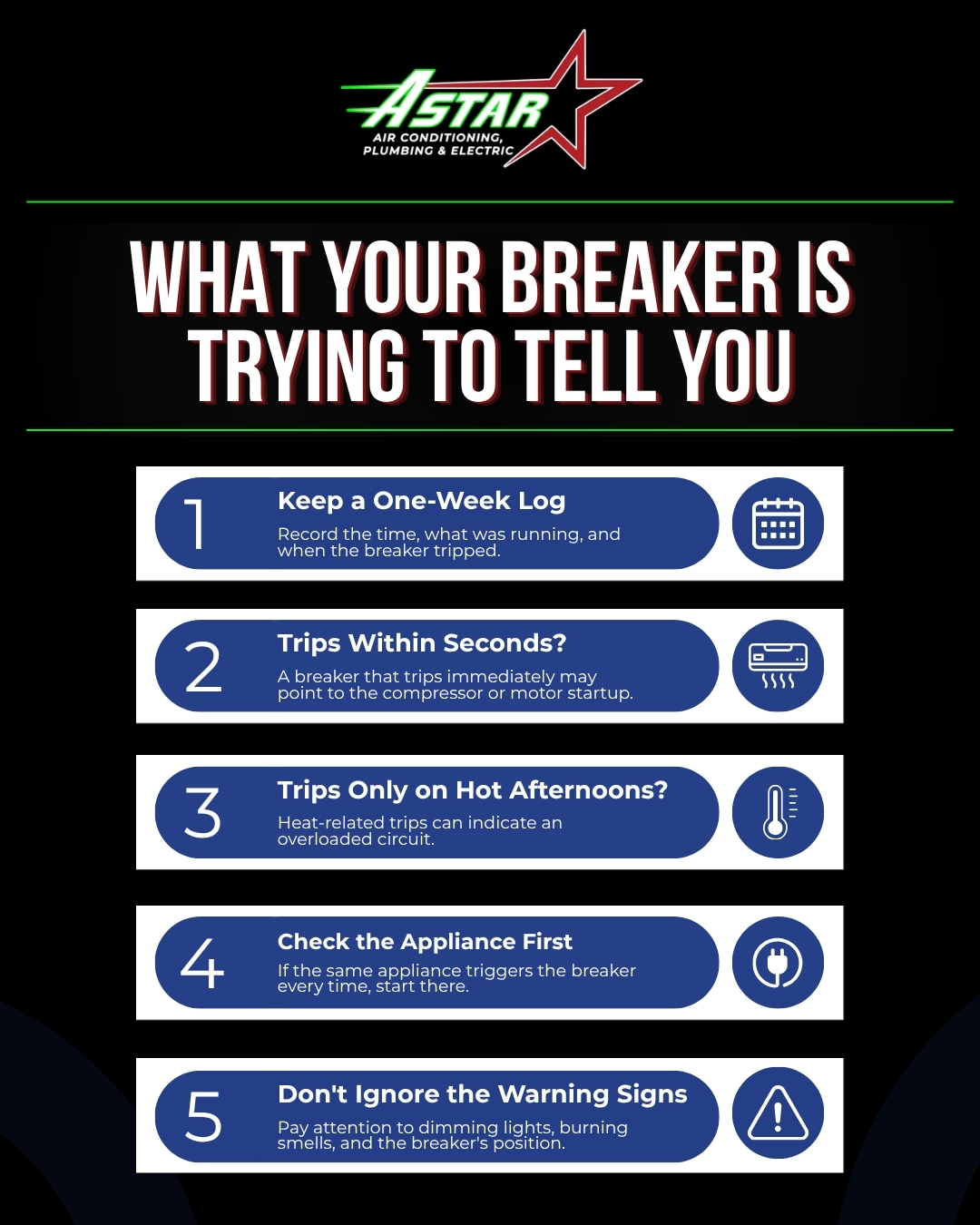
Before anyone arrives, the most useful thing you can do costs nothing. Write down what tripped, what was running, and what time it happened, every time, for a week. Patterns separate the three common causes faster than any tool does.
A breaker that trips within seconds of the compressor starting points at the inrush at motor start or at the condenser circuit itself. A breaker that trips at four in the afternoon on hot days and never in the morning points at accumulated heat plus a circuit sitting close to its limit. A breaker that trips whenever one specific thing runs- the microwave, a window unit, a shop vacuum in the garage- points at that appliance or its receptacle.
Add the boring details:
- Which room lost power.
- Whether the handle went fully to off or stopped in the middle position, which the CPSC guide notes can be hard to see.
- Whether the lights dimmed first.
- Whether anything smelled hot.
Two Extra Problems in Older Fort Worth Houses
Housing stock matters here more than most people expect, because heat punishes bad connections and older homes have more of them.
The first is aluminum branch circuit wiring. A copper shortage in the mid 1960s pushed builders to run aluminum on ordinary 15- and 20-amp circuits, and homes wired between 1965 and the mid 1970s may have it.
CPSC’s companion publication on repairing aluminum wiring, number 516, reports a national survey finding that pre 1972 homes wired with aluminum were 55 times more likely to have one or more connections at outlets reach what the survey defined as fire hazard conditions, compared with copper-wired homes.
The mechanism is exactly the one August makes worse: deterioration at the connection raises resistance, resistance under current produces heat, and the damage accumulates. CPSC also warns that these connections often fail without any warning signs at all.
The second is service capacity. A house built for one central system, a range and a dryer, is now running two systems, a car charger and a garage freezer. The panel may be perfectly sound and still be out of room, and the tell is not a single tripping circuit but a main that gets warm and breakers that trip in rotation across the afternoon.
Neither one is a summer problem exactly.
Summer is just when they surface.
What We Look At on an August Breaker Call
Call a real AC Repair, plumbing & electrical in Fort Worth, TX dispatcher, and us picks up, which is the first thing that shortens an August breaker call. After that, we start at the panel and take its temperature, literally. Thermal imaging on a loaded panel shows a hot lug or a failing breaker in seconds and shows it without guessing. From there, we measure actual load on the suspect circuit under the conditions that produce the trip, which usually means during the hottest part of the day rather than at nine in the morning when everything behaves.
Then we look at the trip itself. A breaker that has opened thousands of times over twenty years is a mechanical device with wear on it, and a breaker that trips at 12 amps on a 20-amp circuit has told you something about itself. We check terminations for heat damage, verify the breaker matches the conductor it protects, and confirm the condenser circuit is sized to the equipment nameplate rather than to whatever was there before the last replacement.
What we do not do is size a panel upgrade off a hot afternoon and a hunch. If the load calculation says the service is adequate and one connection is cooking, the fix is that connection.
In August, that visit is worth booking early in the day. Same-day appointments run across Fort Worth and Tarrant County, and the measurements are more useful when taken while the house is still hot.
Write Down the Trip Pattern Before August Ends
The season is doing your diagnostic work for you right now, and it will stop in about six weeks. A breaker that trips twice a week in August will trip zero times in November, and the underlying loose lug or tired breaker will still be there next June, one summer older. That is why this month is the right time to sort it out rather than the worst time.
Keep the log, reset once and no more, and leave the cover on. When the pattern is clear, or when it trips a second time, call Astar Air Conditioning, Plumbing & Electric at (817) 290-3373, and we will bring a clamp meter and a thermal camera to your driveway the same day.
We have been working on Fort Worth and Tarrant County houses since 1997; we hold Texas electrical contractor license TECL-38309, and you can read what Fort Worth neighbors say about the work before you pick up the phone.