
Yes, a water heater swap in Dallas, Plano, or Garland needs a city permit and a passed inspection, even when the new tank is the same size and fuel as the old one. A homeowner can pull that permit on a homesteaded house and do the work alone. Anyone else doing the job for pay needs a Texas plumbing license, and a quote that never mentions the permit is telling you something.
TL;DR
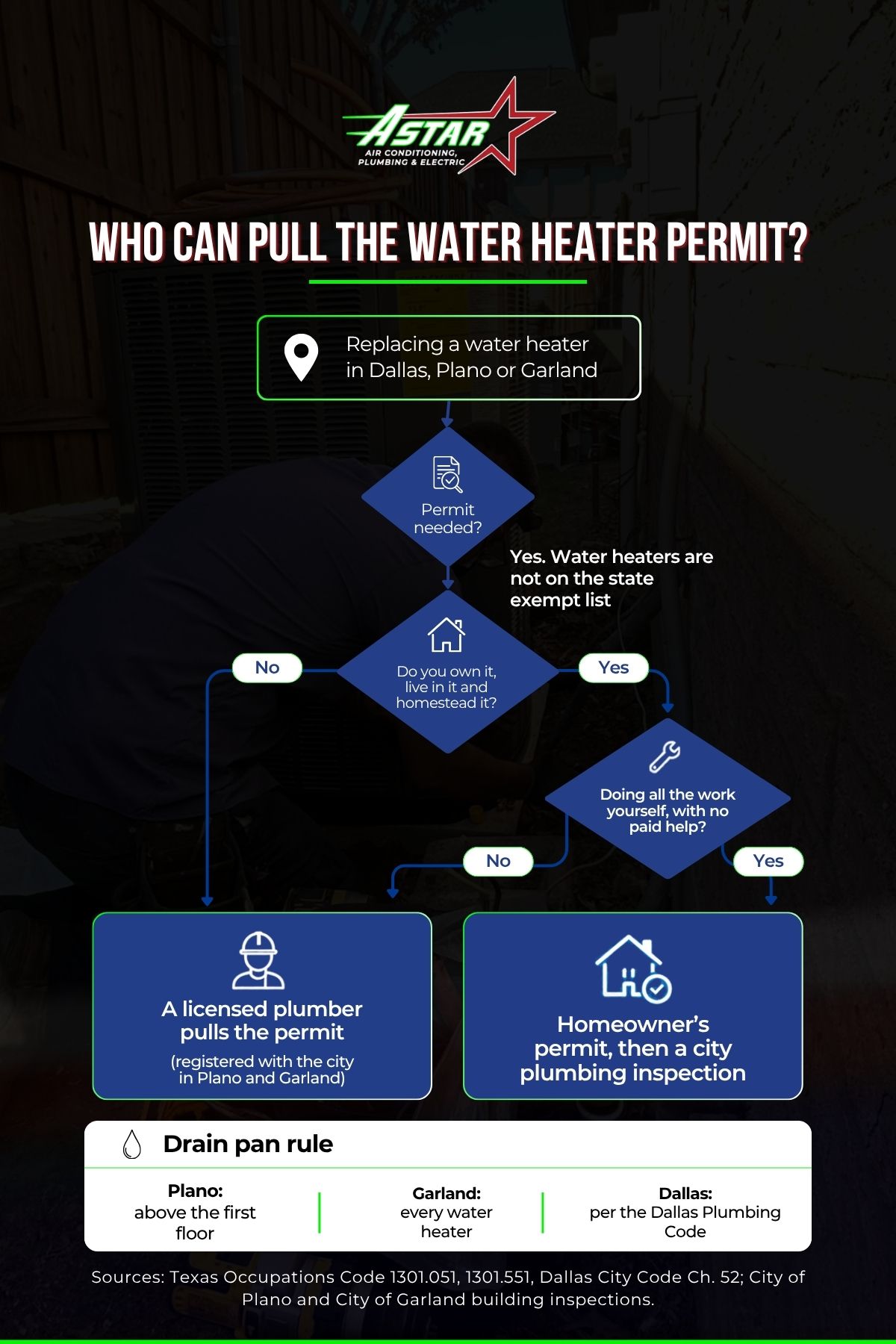
A water heater replacement permit is required in Fort Worth, Keller and Mansfield because Texas plumbing law lists only a handful of jobs a city may exempt, and a water heater is not one of them. The exempt list covers repairing leaks, replacing lavatory or kitchen faucets, ballcocks or water control valves, garbage disposals and toilets. Dallas writes the rule into Chapter 52 of its city code: replacing plumbing fixtures in kind needs no permit, except boilers and water heaters. A homeowner who lives in and has homesteaded the house may pull the permit and do the work personally, with no paid help. Everyone else must be a licensed plumber, and in Plano and Garland the plumber must also be registered with the city. An inspector then checks the relief valve, drain lines, pan, venting and gas shutoff before the job is final.
Does Replacing a Water Heater Need a Permit in Texas?
In any Texas city that regulates plumbing by ordinance, replacing a water heater needs a permit, because state law spells out exactly which small jobs can skip one. Chapter 1301 of the Texas Occupations Code, the Plumbing License Law, requires cities with more than 5,000 inhabitants to regulate “any pipe, faucet, tank, valve, water heater, or other fixture.” It then tells those cities to require a permit for plumbing work, with five named exceptions.
That exception list is short enough to print in full. You can read it yourself in Section 1301.551 of the Texas State Board of Plumbing Examiners’ copy of the Plumbing License Law, dated September 2025.
| Job | Permit under Section 1301.551(c)? |
|---|---|
| Repairing a leak | No |
| Replacing a lavatory or kitchen faucet | No |
| Replacing a ballcock or water control valve | No |
| Replacing a garbage disposal | No |
| Replacing a toilet | No |
| Replacing a water heater | Yes, it is not on the exempt list |
The same section says the inspection must be done by a plumbing inspector. So the permit is only half of the obligation. The other half is a city inspector standing in your garage or attic looking at the finished install.
How Dallas puts it in its own code
Dallas says it even more plainly. Section 301.2.2 of Chapter 52 of the Dallas City Code, the city’s administrative procedures for its construction codes, lets you replace plumbing fixtures in kind without a permit where the rough-in does not change, “except that a permit is required for the replacement of boilers and water heaters.”
Grapevine’s building FAQ is blunter still. It calls it illegal for anyone, even a homeowner, to replace a water heater without a permit.
The Homestead Route, and Where It Stops
Texas lets you do plumbing on your own home without a license. The homestead clause, 1301.051 in the same law, is one sentence: a property owner is not required to be licensed “to perform plumbing in the property owner’s homestead.” That exemption covers the license. It does not cover the permit or the inspection.
The cities are consistent about the conditions. The house has to be yours, you have to live in it, and it has to carry a homestead exemption on the tax roll.
- Dallas: The city’s homeowner exemption form, revised April 2025, lists plumbing work among the jobs a homeowner may do under a homeowner’s permit. You sign an affidavit attesting that you are doing the work yourself and “will not be assisted by any other person performing any part of the work for remuneration.” Staff witnesses the signature, or it gets notarized.
- Garland: You must own the home, live in it, and homestead it through the Dallas Central Appraisal District. The city asks for a driver’s license showing the permit address and checks the homestead exemption itself.
- Plano: Its contractor-selection handout warns against a contractor who asks you to pull the permit for their work, because “you will be responsible for their work.”
That last warning deserves a second look. A handyman who says “just get the permit in your name and I’ll do the install” is asking you to sign an affidavit that is false, and to take the inspection risk for work you did not do. In Dallas, the affidavit’s third clause covers that exact situation: if you break the no-paid-help condition, you agree to hire a properly licensed contractor to secure the permit and finish the job.
Why the store’s installer is not a loophole
People sometimes assume the big box store that sold the tank can send its own installer, licensed or not. State law closes that door. Its appliance dealer clause, 1301.053, exempts appliance dealers who connect appliances to existing openings with an approved connector, and then carves out water heaters by name: “other than installation and service work on water heaters.”
Whoever connects a water heater for pay in Dallas County or Collin County needs a plumbing license. The retail receipt does not change that.
What the Inspector Looks at in Plano and Garland
Both cities publish what they want to see, and they do not want quite the same things. Plano still serves its one-page diagram at plano.gov/waterheater, and Garland lays out its standard requirements on Garland’s water heater replacement page, which also lists its fee.
| Item | Plano (Building Inspections handout) | Garland (water heater replacement page) |
|---|---|---|
| Temperature and pressure (T&P) relief valve | Required; drain runs with fall to the exterior between 6 and 24 inches above grade, a floor sink, or a mop sink | Required and must work; the inspector lifts it, and it must not stick open |
| T&P drain line | May not drain into the pan | At least 3/4-inch copper or CPVC, ending on the garage floor or outside, turned down about 6 inches off the floor or ground |
| Drain pan | Required above the first floor; not required for an electric heater on the first floor | Required on any water heater |
| Cold water shutoff | Required and readily accessible | Required on the cold pipe at the heater |
| Garage elevation | 18-inch stand or ignition source 18 inches up, unless listed flammable vapor resistant or electric | Required when the ignition source is under 18 inches, or when the manufacturer says so |
| Gas shutoff | Accessible, approved valve with no more than 3 feet of flex connector, not concealed | Within 6 feet of the heater, accessible and in the same room |
| Vent | Type B double wall, 1 inch to combustibles, at least 5 feet vertical to a listed cap | Type B through the attic or other concealed space, 1 inch clearance to sheetrock, wood, and insulation |
| Fee | Not stated on the handout | $88 residential ($70 plus an $18 processing fee) |
The pan row is the one that catches people. A house in Plano with an electric tank on a first-floor slab does not need a pan by that handout. Garland wants one on every heater.
Dallas does not publish a one-page water heater diagram that we could find. Its plumbing permit checklist says every installation must comply with the current Dallas Plumbing and Fuel Gas Codes, and that is what its inspectors work from.
Where the Heater Sits Changes the Job
Location decides how much of that table applies to you. A garage heater, an attic heater, and a closet heater are three different inspections.
Garages bring the elevation rule and the drain termination. The trap is a new model that is taller, or a different fuel, than the tank it replaces, because the stand, the vent, and the drain were all built around the old one.
Attics are where Garland’s page gets specific. Its list for an attic unit:
- The heater must be within 20 feet of the attic access.
- Permanent steps or a permanent ladder is required; pull-down stairs rated for 300 pounds count.
- The access and the path must be big enough to get the new heater in and the old one out.
- A 24-inch catwalk with solid flooring leads to the unit.
- A 30-inch by 30-inch work platform sits in front of the controls.
- A switched light fixture goes in the passageway opening.
- A pan with a drain that ends outside, and for gas, a vent cap at least 5 feet above the draft collar.
An attic heater that went in years ago was inspected against the rules of its day, and the replacement is inspected against today’s list. If you have an attic unit in Garland and the pull-down stairs feel flimsy, find out before you book the job.
Closets are the gas question. Garland requires a gas water heater in a bathroom or bedroom to sit inside a closet used only for the heater, with a threshold and a solid, weather-stripped door, plus combustion air openings near the top and bottom when the room is too small. Plano sets the same confined-space line at 50 cubic feet for each 1,000 BTU of input, with openings within 12 inches of the top and bottom.
What Happens If It Was Done Without a Permit?
In Dallas, you end up paying the permit fee twice, plus at least $100. Section 303.7 of Chapter 52 says that when permitted work starts without a permit, the city makes a special investigation before it will issue one. The investigation fee equals the permit fee plus $100.00 per hour per trade review, with a one-hour minimum, and it is charged whether or not the permit is later issued.
Paying it does not excuse the installation from the code. Anything that would have failed inspection still has to be fixed.
Plano’s handout adds the resale angle. It warns that work done contrary to city ordinances “can drastically affect any title transfers or insurance requirements, should you ever decide to sell your home.” We cannot tell you what a particular buyer or insurer will do with an unpermitted heater. We can tell you it is the kind of question that comes up at the worst possible moment, during an option period with a closing date on the calendar.
Tank to Tankless Is a Bigger Permit
Switching fuel or switching to a tankless unit moves the job out of “replace in kind” territory. Plano’s handout says tankless heaters follow the manufacturer’s instructions and the International Fuel Gas Code for gas line size and venting, and that “a gas load calculation shall be provided on the jobsite when calling the first inspection.”
That calculation exists because a tankless burner can ask the gas line for far more at once than a storage tank ever did. If the answer comes back short, the permit grows to include gas piping. Our page on switching to a tankless unit covers the heater side, and upsizing the supply is its own piece of gas line work that gets inspected in its own right.
Reading a Quote for the Permit Line
A quote either shows the permit as a line item or says nothing about it, and silence is the one to ask about. Here is what to check before you say yes, whichever company you hire.
- The quote names who pulls the permit, and it is the plumbing company, not you.
- The plumber holds a Texas license, and in Plano and Garland is registered with the city.
- The permit fee appears on the quote or is stated as included.
- Code items the old install lacked (a pan, a shutoff, a proper T&P drain) are priced, not discovered later.
- Someone will be home for the final inspection; Garland requires an adult over 18 to be present.
- You get the permit number, so you can check the inspection result yourself.
Plano’s handout asks homeowners to insist on seeing the permit before the project begins and to monitor the inspection record during it. That is sound advice anywhere in Dallas County or Collin County. If you are still weighing the numbers, our breakdown of what a replacement costs in Dallas walks through the rest of the quote.
When doing it yourself makes sense
If the house is your homestead, the new heater is the same fuel and size in the same spot, and you are comfortable with a gas connector and a vent connector, the homeowner permit is a legitimate route. Budget time for the affidavit, the inspection window, and any code item the old install was missing. If any one of those conditions is shaky, the licensed route is usually cheaper than a failed inspection and a second trip.
Ask Whose Name Goes on the Permit
The single question that sorts a good quote from a risky one is short: whose name goes on the permit? If the answer is the plumbing company’s, the license, the city registration, and the inspection all sit with the people doing the work.
That is how we handle it. For water heater installation anywhere we work, from our office on Forest Lane in Dallas out to Plano homes and Garland homes, our licensed plumbers pull the permit and meet the code so the paperwork is not yours to chase. Call Astar Air Conditioning, Plumbing & Electric and ask us to put the permit on the quote in writing.