If Fort Worth Water has told you your address is “galvanized requiring replacement”, it means the short pipe you own, running from the water meter to your house, is galvanized steel that once sat downstream of a lead line on the city’s side. It is not a finding that your water contains lead. It is a flag that this pipe has to go eventually, and you have three sensible ways to respond.
TL;DR
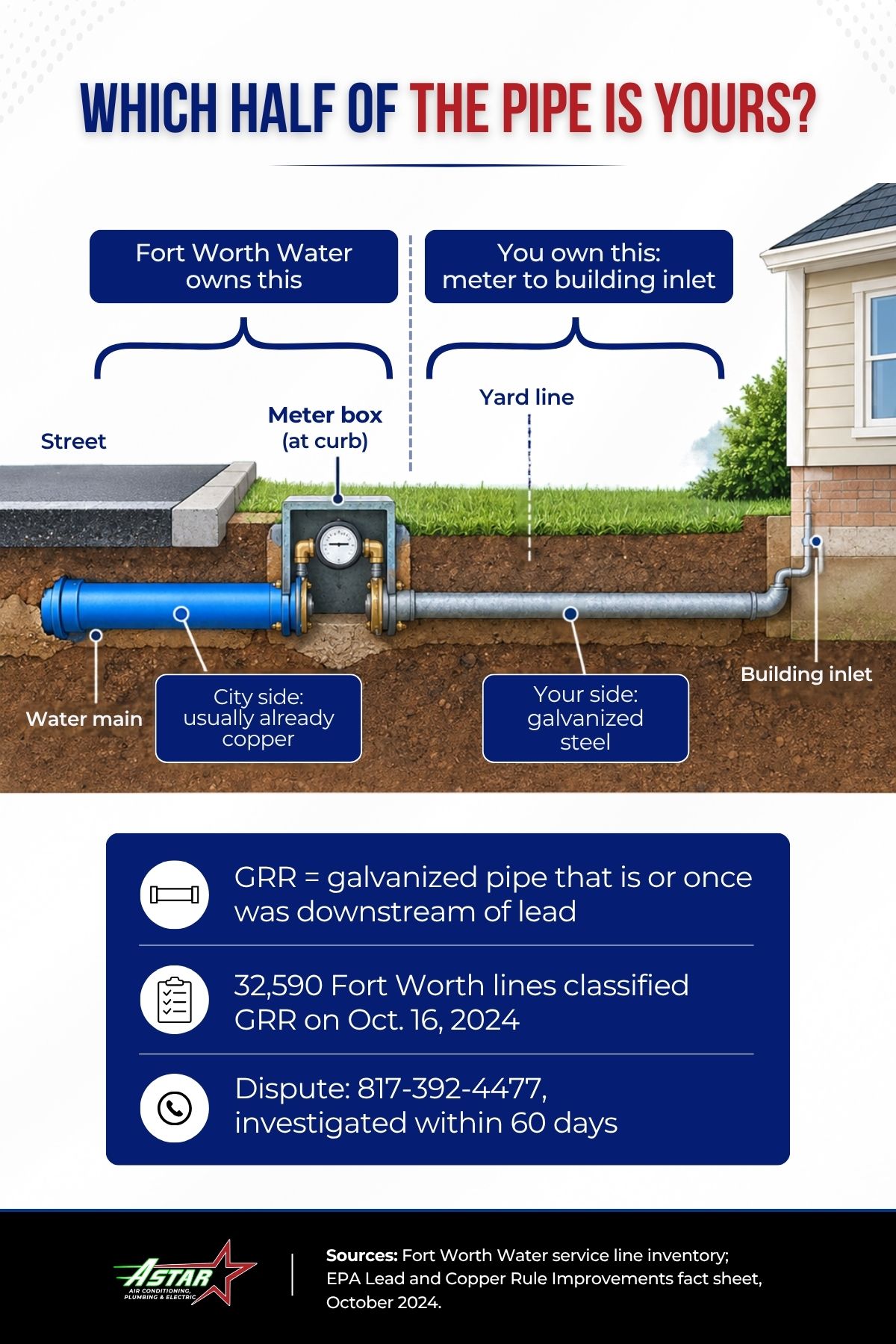
Galvanized requiring replacement (GRR) is a federal inventory category. Fort Worth Water uses it when the customer’s portion of a water service line is galvanized pipe that is, or once was, downstream of a lead service line on the utility’s portion. The utility owns the line from the main to the meter; the property owner owns it from the meter to the building inlet. On October 16, 2024, Fort Worth classified 32,590 service lines as GRR. Under EPA’s Lead and Copper Rule Improvements, water systems must fully replace lead and GRR lines under their control within 10 years, with the first program year starting November 1, 2027. A homeowner can dispute the label, request the free lead test the utility offers to GRR addresses, request replacement funding through the city, or have the customer side replaced privately.
Which Part of the Pipe Is Actually Yours?
In Fort Worth, you own the stretch from the meter to the point where the pipe enters your house. The city’s service line inventory page says the utility owns from the main to the meter, and property owners are responsible “from the meter to the building inlet.” The meter box near the curb is the dividing line.
That short run of yard pipe is the entire subject of your letter. Nothing inside the walls was classified, and the label does not describe your kitchen plumbing.
| Stretch of pipe | Who owns it in Fort Worth | What the inventory says about it |
|---|---|---|
| Water main under the street | Fort Worth Water | Not part of the label |
| Main to meter (utility side) | Fort Worth Water | Recorded as the “city side” material |
| Meter to building inlet (customer side) | You | Recorded as galvanized on every GRR address |
| Pipes inside the house | You | Not classified at all |
If you are just outside the city limits
Several towns around us buy water from Fort Worth or run their own systems, so check whose name is on the bill before you assume anything. Haltom City, where our office is, keeps its own inventory and draws the ownership line in the same place: its FAQ says the city owns the main and the line up to the meter, and the property owner owns the line from the meter into the building. The Fort Worth map still lists 30 GRR addresses tagged Haltom City, which tells you some Haltom City homes sit on Fort Worth Water service.
Why a Pipe With No Lead in It Gets This Label
Galvanized steel is iron or steel dipped in zinc. EPA’s technical fact sheet on the rule defines a GRR line as a galvanized service line that “currently is or ever was downstream of a lead service line,” and adds the clause that catches most addresses: if the water system cannot demonstrate that the galvanized line was never downstream of lead, it is GRR.
Fort Worth’s own definition is narrower in wording but lands in the same place. The customer’s portion is galvanized pipe “confirmed to be or at one time to have been downstream of a lead service line as the utility’s portion.”
Read that twice and the logic of your letter becomes clear. The worry is not the galvanized pipe itself. The worry is what the inside of an old galvanized pipe may have collected from lead upstream of it, years ago.
What the live map says about the city side today
We queried the public layer behind Fort Worth Water’s service line map on September 22, 2026. It holds 22,936 GRR addresses, and in 22,909 of them the city’s side is now recorded as copper. Only 399 records are marked as confirmed to have once been lead; the rest are marked “Don’t Know”.
So for most flagged homes the picture is simple: the city’s side was already swapped at some point, and the old galvanized yard line on the owner’s side was left in place. That leftover is the pipe the rule wants gone.
The map count is lower than the 32,590 published for October 2024. The city’s page does not say why, so we are not going to guess whether the difference is replacements, disputes that succeeded, or something else.
Where the Flagged Lines Cluster in Fort Worth
The GRR layer is not spread evenly. It sits in the older central and west side neighbourhoods, which is where galvanized yard lines were laid and where the city side was later replaced.
| ZIP code | GRR addresses on the map (Sept 22, 2026) |
|---|---|
| 76107 | 2,969 |
| 76110 | 2,346 |
| 76105 | 2,149 |
| 76112 | 2,128 |
| 76119 | 1,841 |
| 76116 | 1,814 |
| 76164 | 1,738 |
| 76109 | 1,369 |
A few street names in plain language: 76107 covers the older houses around Arlington Heights, 76110 includes Fairmount and its tree-lined historic blocks, 76116 is Ridglea, 76109 is TCU and Westcliff, and 76164 is the Stockyards and the North Side. By contrast, the whole Far North and Alliance side of Fort Worth barely registers.
The map’s separate lead layer holds 17 addresses, all in 76107. If your letter says lead rather than galvanized, that is a different conversation and a more urgent one.
Do You Have to Replace It, and By When?
No law we can point to makes a Fort Worth homeowner replace a GRR line on a date. The deadline sits with the water system. EPA’s fact sheet says community water systems must fully replace all lead and GRR service lines under their control within 10 years, and the first program year runs from November 1, 2027 to December 31, 2028.
Two details in that fact sheet matter to you as the owner.
- A line counts as fully replaced only when the entire length, both the customer side and the system side, is non-lead. The utility cannot hit its target by leaving your galvanized half in the ground.
- Where the utility needs your consent, it has to make a “reasonable effort” to get it: at least four attempts using at least two different methods, such as a letter, a door hanger, a phone call or a visit.
In practice, that means you will keep hearing about this. The rule also requires annual notification to addresses with lead or GRR lines whether or not the owner agrees to a replacement.
The partial replacement trap
The rule prohibits partial replacements except in an emergency repair or when the line is disturbed by other planned work, such as a water main or meter replacement. When a partial swap does happen, the utility must fit a dielectric coupling between old and new pipe to prevent galvanic corrosion, unless the new pipe is plastic.
That is worth knowing if anyone offers to “just do the bit by the house”. A half-replaced galvanized line is still a GRR line on paper.
Three Ways to Answer the Letter
Most people we talk to assume the letter is a bill in disguise. It is not, and you have real choices. Here is how they compare.
| Option | When it fits | What you do | What you should know |
|---|---|---|---|
| Dispute the label | Your yard line was already replaced, or you can see copper or plastic at the meter box | Submit the city’s Dispute Service Line Material form or call 817-392-4477 | Fort Worth says staff will investigate within 60 days |
| Test and wait for the utility program | The line is galvanized, and you want data before spending | Request the free lead test Fort Worth offers to GRR, lead and unknown addresses, and submit the city’s replacement funding request | The city page does not publish funding eligibility or amounts |
| Replace the customer side now | You are renovating, selling, or the old line is already giving trouble | Hire a licensed plumber to replace meter to house, then file the dispute form with proof | You pay; keep the invoice and photos |
How to check the pipe yourself before you choose
Fort Worth’s guide to identifying service line material asks for two things you already own: a flathead screwdriver and a fridge magnet. Scratch the pipe where it comes up near the meter or where it enters the house.
- Dull gray under the scratch and the magnet sticks: galvanized steel
- The colour of a penny and the magnet does not stick: copper
- Shiny silver under the scratch and the magnet does not stick: lead
If you find copper or plastic where the map says galvanized, the dispute form is your fastest route. If you find shiny silver, stop and call Fort Worth Water.
The option we would pick in your shoes
For most flagged houses, we would start with the free test and the funding request, because both cost nothing and the utility has to replace this line anyway. The Texas Water Development Board approved $13,265,306 for Fort Worth’s lead service line replacement project on October 17, 2024, of which $6,765,306 was principal forgiveness, according to the Texas Water Development Board’s announcement.
The exception is the house that is going to be opened up anyway. If you are already planning whole house repiping for an older home, replacing the yard line in the same job saves digging twice.
Selling or Buying a Flagged House
A GRR label follows the address, not the owner, and it is public. Anyone can look up a Fort Worth address on the city’s map.
The EPA fact sheet adds a rule aimed squarely at this moment. Within six months of a change in property ownership, the water system must offer full service line replacement to the new owner, and within a year it must make that reasonable effort to get the owner’s consent. A buyer in Arlington Heights or Fairmount should expect that conversation in the first year.
For sellers, the practical question is whether to replace and then dispute before listing, so the map shows non-lead when buyers look. That is a pricing and timing call rather than a legal one.
What Happens the Day the Pipe Is Swapped?
For a day or two after the swap, expect the water to need flushing. EPA’s fact sheet explains that replacement work can break apart corrosion scale and cause temporary increases in lead, so the rule makes the utility provide three things before the line goes back into service.
- A notice that lead levels may rise temporarily, with the utility’s contact details
- Written instructions for flushing the service line and the plumbing inside the house
- A pitcher filter or point-of-use device certified to reduce lead, with six months of replacement cartridges
The utility must also offer a follow-up tap sample between three and six months after the work. Take it.
If you replace the customer side privately, those rule-driven steps belong to the utility’s program, not to your plumber, so ask Fort Worth Water about flushing and testing before the job starts.
Look Up Your Address, Then Call Us With What It Says
Start with Fort Worth Water’s service line inventory, which links to the map, the dispute form, and the funding request. Find your address, note what it says about both sides of the line, and do the scratch test at the meter box. The full rule text for homeowners is in EPA’s service line fact sheet.
If the map and the pipe disagree, file the dispute. If they agree and you want the yard line gone on your schedule rather than the city’s, our licensed plumbers in Fort Worth can quote the meter-to-house run. We have served Fort Worth and Tarrant County homes from Haltom City for years, and Astar Air Conditioning, Plumbing & Electric will tell you honestly whether waiting for the utility is the better deal.