Fort Worth gets one genuinely cold night in late autumn; everybody reaches for the thermostat at roughly the same hour, and within twenty minutes a good number of houses smell like something is on fire. Most of them are fine. The point of this page is knowing which ones are not.
TL;DR
A hot, dusty, slightly scorched smell in the first few minutes of the first heating cycle is usually dust that has settled on a heat exchanger and burners over months of disuse, burning off. It fades within a cycle or two and does not come back. What does not fit that pattern deserves attention rather than patience: a smell that persists past a few cycles, an electrical or plastic smell, or any smell accompanied by how people in the house feel. The EPA notes that carbon monoxide can cause flu-like symptoms that clear up after leaving home, which is the single most useful thing a homeowner can know, because it describes a pattern rather than a smell. Carbon monoxide has no odour, so the nose alone is not a test. And the US Fire Administration reports that heating fires were the second leading cause of home fires in 2021, with an estimated 32,200 of them, which is why the annual professional inspection it recommends is not a sales line.
If anyone in the house has symptoms, leave first and call from outside. Do not troubleshoot a suspected carbon monoxide problem from inside the building.
The Normal Version, and How It Behaves
Dust burn-off has a signature, and the signature is about time rather than intensity.
A furnace that has sat unused since spring collects dust on surfaces that get hot. When heat is applied for the first time, that dust burns off and produces exactly the smell people describe. Ours is a climate where the system can sit idle for the best part of eight months, so there is more of it here than in places with shorter cooling seasons.
The pattern to expect:
- It starts within the first few minutes of the first cycle
- It is strongest at the beginning and diminishes as the cycle runs
- It is noticeably weaker on the second cycle and largely gone by the third
- Nobody feels unwell
- It does not return the next day
If all five of those are true, what you have is a dirty system rather than a broken one, and the smell is a signal to get the annual service booked rather than an emergency.
Why the first cold night is when this happens
There is a reason the calls cluster. The first sustained cold in Tarrant County arrives suddenly rather than gradually, and a system that has run in cooling mode all summer switches to heating for the first time on that evening, with everyone doing it at once.
That is also why the ideal time for a heating check is the month before that night rather than the week after it. A system looked at in October has the burn-off happen with a technician present and the filter already changed.
What Does Not Fit the Pattern
Five departures from the picture above, each meaning something different.
| What you notice | What it suggests |
| Smell persists past three or four cycles | Not simple dust. Worth a look |
| Smell of hot plastic or melting insulation | Electrical, and not something to keep running |
| Sharp, acrid, or chemical smell | Not dust burn-off. Stop and get it checked |
| Smell of gas, or a sulphur or rotten-egg odour | Leave the building and call the gas utility from outside |
| Any smell plus how people feel | Treat as carbon monoxide until proven otherwise |
That last row is the one this page exists for, and it deserves its own section.
The Symptom Pattern That Matters More Than the Smell
Carbon monoxide is the reason a burning smell is worth taking seriously, even though carbon monoxide itself does not smell of anything.
The EPA describes the health effects by concentration. At moderate concentrations, it lists angina, impaired vision, and reduced brain function. At higher concentrations, it lists impaired vision and coordination, headaches, dizziness, confusion, and nausea, and states it is fatal at very high concentrations. It explains that acute effects come from the formation of carboxyhemoglobin in the blood, which inhibits oxygen intake. Its guidance is from the EPA on carbon monoxide and indoor air quality.
The line that turns this into something a household can actually use is this: the EPA notes carbon monoxide can cause flu-like symptoms that clear up after leaving home.
That is a pattern rather than a symptom. A headache is a headache. A headache that several people in the house have, that lifts when they go out and returns when they come back, is a different piece of information entirely, and it is the version that gets missed because everyone assumes it is a virus going round in November.
The EPA also names the sources, and one of them is directly relevant here: worn or poorly adjusted and maintained combustion devices. It states that it is most important to be sure combustion equipment is maintained and properly adjusted.
What to do, in order
- If anyone has symptoms, get everyone out of the house first. Fresh air, then call
- Call from outside, not from inside
- Do not go back in to open windows, switch the system off, or investigate
- If nobody has symptoms but the smell is wrong, switch the system off at the thermostat and book a look at it
- Never treat a working carbon monoxide alarm as a faulty alarm
Point five gets ignored more than any other. An alarm that sounds is doing its job, and the correct response is to leave and call, not to take the battery out.
Why the Annual Check Is Not a Sales Line
Heating equipment is a genuine fire risk category, and the numbers are federal rather than ours.
The US Fire Administration reports that although trending downward since the early 1980s, heating fires remained the second leading cause of home fires in 2021, with an estimated 32,200 home heating fires reported to US fire departments, causing an estimated 190 deaths, 625 injuries, and 442 million dollars in property loss. Its guidance is available at the US Fire Administration on heating fire safety.
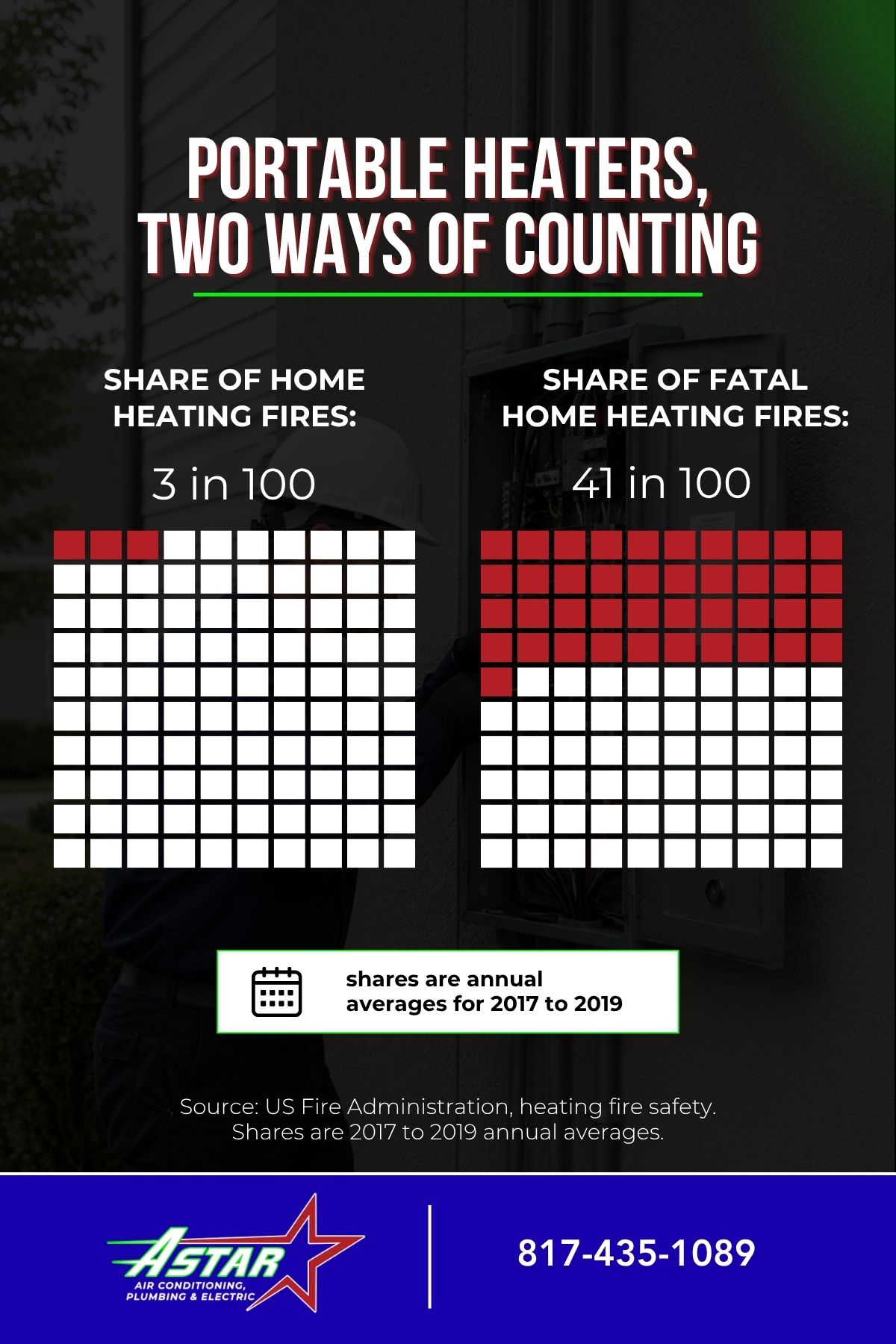
There is a striking figure in the same material about portable heaters. They accounted for only 3 percent of all home heating fires annually across 2017 to 2019, and 41 percent of fatal heating fires in homes. That disproportion is worth knowing in a month when people reach for a space heater because the main system smells odd.
The agency’s own prevention advice is short and includes keeping anything that can burn at least three feet from all heat sources, never using an oven to heat a home, turning space heaters off when leaving the room or going to bed, and maintaining heating equipment and chimneys by having them cleaned and inspected each year by a professional.
That last item is the annual service, recommended by a federal fire agency rather than by a contractor.
The Space Heater Decision People Make That Week
Worth its own section because it is the choice most households actually make when the main system smells wrong, and the federal numbers on it are stark.
The US Fire Administration reports that home portable heater fires were only 3 percent of all home heating fires annually across 2017 to 2019, yet accounted for 41 percent of fatal heating fires in homes. A category responsible for a small share of fires and a large share of deaths is telling you something specific about how those fires happen, which is that they start in occupied rooms while people are asleep or absent.
Its prevention advice speaks directly to that. Keep anything that can burn at least three feet from all heat sources. Turn space heaters off when leaving the room or going to bed. Never use an oven to heat a home.
The trap in the sequence
Here is how it goes wrong. The furnace smells odd on the first cold night, somebody decides to leave it off until it can be looked at, and a portable heater comes out of the garage to cover the gap. That is a reasonable decision made from caution, and it swaps a system with a fault of unknown seriousness for a device category with a documented fatality profile.
If a heater is the bridge, treat it as a bridge. Three feet of clearance, off when the room empties, off at bedtime, and a booked appointment rather than an open-ended arrangement. The gap should be days, not a season.
What a Heating Check Actually Covers
Worth being specific, because “annual maintenance” sounds like a euphemism for a look and an invoice.
On a gas system, the parts that matter to this page are the combustion side and the venting. The heat exchanger, the burners, the flue, and the draft are what determine whether combustion products go outside or into the house, and they are what a smell in a cold snap is really asking a question about.
Around that sit the ordinary items: the filter, the blower, the ignition, the controls, and the safeties. None of those is glamorous, and all of them are cheaper to attend to in October than in January, when everyone in Fort Worth is calling at once.
Our heating services page covers what we do, and if a system has already stopped, emergency heating is the faster route. If the smell you are describing turns out to be electrical rather than combustion, that is a different trade and our electrical side handles it.
The Question We Get Asked Next
People almost always ask whether an old system is inherently dangerous, and the honest answer is more useful than a yes or a no.
Age on its own is not the risk. A maintained older system with an intact heat exchanger and clear venting is not a hazard, and a neglected newer one can be. What age changes is the probability that something has gone unattended, and how long it has gone unattended.
What matters is whether it has been looked at. A system nobody has inspected in five years is an unknown regardless of its date of manufacture, and the burning smell on a cold night is a reasonable moment to stop it being unknown.
The two things worth having in the house
Neither costs much, and both change what happens on a bad night.
A working carbon monoxide alarm is the first, and the important word is working. Alarms have an end of life; they are not the same device as a smoke alarm, and one sitting in a drawer since a battery chirped is not protection. Check the date on the back of yours, because the unit itself expires whether or not the battery is fresh.
The second is knowing where your gas shut-off is, and knowing it before you need it rather than in the dark with a torch. That is a two-minute thing to establish on a calm afternoon and an impossible thing to establish while a house is being evacuated.
Neither of those is a substitute for having the system looked at. They are what makes the difference between a problem you find out about early and one you find out about late.
The same logic applies to the wider system. We have written separately on why breakers trip in summer, which is the warm-weather version of the same idea: the first heavy demand of a season is when the thing nobody checked announces itself.
Book the Heating Check Before the First Cold Night
If the heat has not run since spring, the useful time to have it looked at is now rather than on the evening it first goes on. Astar Air Conditioning, Plumbing & Electric covers the city, and a heating visit before the cold arrives is a short appointment that makes the smell question answerable in advance.